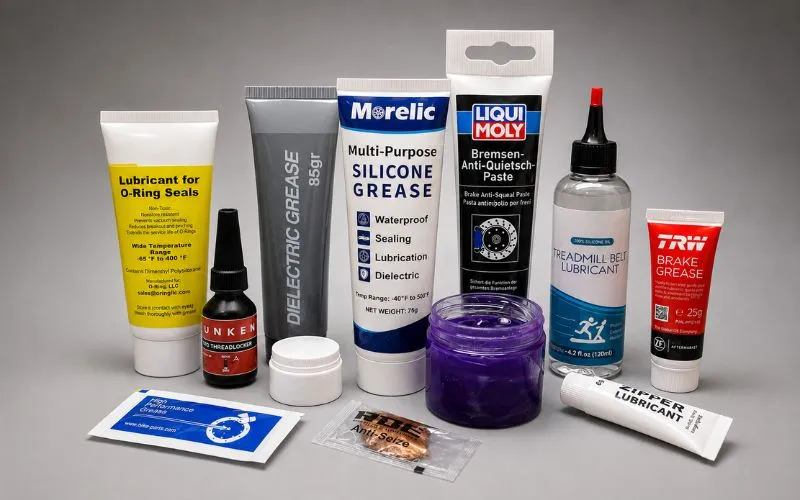
one-stop solution of SMALL-PACK GREASE & Adhesive
Morelic provides silicone-based dielectric grease for electrical connectors, spark plug boots, battery terminals, lighting sockets, and moisture-exposed electrical assemblies.
15+
Years Experience
30+
Industries Served
5,000+
Application Cases
50+
Countries Exported
Flexible MOQ
Global Compliance
Dielectric grease is a non-curing, electrically insulating grease commonly used around electrical connectors, spark plug boots, bulb sockets, battery terminals and trailer plugs. It helps seal out moisture, dirt and corrosion while keeping rubber boots, seals and connector housings easier to assemble and remove.
Important: Dielectric grease is insulating, not conductive. It should be applied correctly around connectors, boots and sealing areas. It should not be used as a conductive paste between metal contact surfaces.
Helps protect connectors from water, rain, fog and salt spray.
Helps reduce tracking, arcing and voltage leakage risk when used correctly.
Helps block dirt, salt and moisture from connector areas.
Helps spark plug boots and rubber seals assemble smoothly.
As a silicone-based grease, it does not dry like many temporary lubricants.
Procurement and engineering teams face specific challenges with electrical connections and kit packaging. Here is how proper grease selection helps.
Outdoor, marine, and vehicle connectors are often exposed to rain, humidity, washing, and salt spray.
Battery terminals, trailer plugs, and electrical contacts may corrode when exposed to moisture and road salts.
Spark plug boots and ignition systems require protection around the boot and ceramic area without blocking the electrical contact.
The wrong grease may affect rubber boots, connector housings, or O-rings. Application testing is recommended.
Retail-ready grease packaging must remain clean, sealed, and stable during global transit.
Importers and brand owners need MSDS, TDS, RoHS, REACH, and product labels for customs, retail, and compliance review.
Typical values and ranges are for page structure only. Final values depend on the selected formula and TDS.
| Parameter | Typical Options / Range |
|---|---|
| Base System | Silicone oil-based system |
| Thickener | Silica, PTFE or customized |
| Appearance | Translucent, white, off-white, custom |
| NLGI Grade | 1, 2, 2–3 or customized |
| Service Temp | -40°C to +200°C (Common grades) |
| Dielectric Property | Electrically insulating |
| Water Resistance | Good moisture barrier |
| Rubber/Plastic | Suitable for many boots/housings |
Applied inside the boot or around the ceramic area to help seal moisture and reduce arcing risk. Avoid coating the metal terminal contact.
Used around the assembled terminal area to help repel moisture, dirt, and corrosion. Maintain metal-to-metal contact where current must flow.
Suitable for connector housings, cable plugs, and moisture-exposed electrical interfaces that need sealing and insulation.
Helps protect trailer plugs, RV wiring connectors, and outdoor electrical couplings exposed to road water and dirt.
Used around boat electronics connectors, shore power inlets, and exposed terminals where humidity and salt are common.
Helps protect bulb sockets, outdoor lighting connectors, LED signs, and low-voltage lighting components.
Helps lubricate and seal rubber or plastic parts around electrical assemblies. Compatibility testing is recommended.
Used by maintenance teams for connectors, terminals, control panels, and moisture-exposed electrical components.
Because dielectric grease is insulating, proper application is critical to avoid blocking electrical current between weak contacts.
Make sure the electrical system, ignition system or device is turned off before application.
Remove dirt, old grease, corrosion and moisture before applying new grease.
Use a small amount on the rubber boot, connector seal, outer terminal area or surrounding protection area.
Do not use dielectric grease as a conductive bridge. Ensure the actual metal contacts are properly connected.
Reassemble the connector or boot and check that the fit is tight, clean and secure.
Pro Tip: A little goes a long way. Too much grease can create messy assembly and increase the risk of user misunderstanding.
Understanding the difference is critical for B2B procurement to avoid product misuse in the field.
| Comparison Item | Dielectric Grease | Conductive Grease |
|---|---|---|
| Electrical Behavior | Electrically insulating | Electrically conductive (Contains Metal Particles) |
| Main Function | Seals, protects and insulates around connectors | Improves electrical contact in specific conductive applications |
| Typical Base | Silicone-based grease with thickener | Grease with conductive fillers (carbon, silver, etc.) |
| Where To Apply | Around connector seals, boots, terminal protection areas | Between approved conductive surfaces where conductivity is required |
| Risk If Misused | May block current if placed incorrectly between weak metal contacts | May cause short circuits if used in the wrong place |
Summary: Choose dielectric grease when the goal is sealing, moisture protection and insulation. Choose conductive grease only when the application specifically requires electrical conductivity and the circuit design allows it.
A simple decision flow for B2B buyers selecting formulas and packaging.
Spark plug boots, battery terminals, trailer plugs, repair kits.
Indoor/outdoor, rain, salt spray, heat, frequent disassembly.
Rubber boot, plastic housing, metal. Testing recommended.
Sachets, tubes, syringes, jars or bulk pails.
MSDS, TDS, COA, label warnings, barcode.
Morelic supports comprehensive customization, from specialized grease formulations to shelf-ready packaging, ensuring your brand delivers high-performance solutions to the market.
Custom adjustments for Base Oil Viscosity, NLGI Grade, and specific performance additives.
Expert formulation of cost-effective, high-performance alternatives to major global brands.
Engineering for extreme temperatures, high vacuum, or food-grade (NSF) compliance.
1-10g tear pouches, 3-120g squeeze tubes, jars, bottles, pails, and drums.
Custom logo pre-printing and bespoke label design for your brand identity.
Retail-friendly packaging solutions for hardware, automotive, and plumbing distributors.
Partner with industry experts for high-performance grease formulation and ready-to-sell packaging solutions.
Avoid field failures by understanding the limitations of insulating grease.
Dielectric grease is insulating. If the application requires electrical conductivity, use a suitable conductive grease.
Too much grease may create messy assembly and confuse end users. Apply a thin layer in the correct area.
It is not designed for heavy-load bearings or high-speed metal lubrication. Consider PTFE or PFPE grease for extremes.
Silicone contamination may affect coating or adhesion. Confirm the next process before use.
Food-grade or NSF H1-related options require a specific formula and supporting documentation.
Test before mass production if the connector uses sensitive rubber, transparent plastics or special coatings.
We bridge the gap between bulk grease manufacturing and retail-ready packaging.
Morelic is built for tubes, sachets, syringes, jars and kit-ready grease packaging, not only bulk grease supply.
Share your connector type, environment, and packaging target. We recommend a suitable dielectric grease direction before sampling.
We support pre-print and custom labels, carton artwork, barcode placement, and sample mockups for retail and repair kit projects.
Our small-pack filling process is designed for stable weight control, clean appearance and reduced leakage risk during export shipping.
MSDS, TDS, COA and formula-related documents can be prepared according to the selected product and destination market.
Morelic supports sample testing, pilot orders, packaging confirmation and repeat production for long-term OEM projects.
How Morelic processes your dielectric grease OEM order.
For B2B buyers, dielectric grease is not only a product formula. It also requires stable batch control, packaging reliability, and documents that support import, distribution, and customer review.
Appearance, consistency, filling weight, and sealing quality are checked during production.
Rubber, plastic, and metal compatibility can be reviewed based on customer materials and application conditions.
MSDS, TDS, RoHS, REACH, COA, and custom label information are available upon request.
Carton labels, product labels, packing information, and shipping document support for global customers.
Need MSDS, TDS, or compliance documents before ordering?
Needs: spark plug boot grease, battery terminal grease, repair kit sachets.
Support: custom sachets, small tubes, private labels, TDS/MSDS.
Needs: connector protection grease, outdoor repair packs.
Support: syringes, tubes, application instructions and documentation.
Needs: retail-ready dielectric grease in small tubes or carded packs.
Support: label design support, barcode, carton mark, export packaging.
Needs: clean appearance, repeatable packaging, clear usage instructions.
Support: private-label tubes, syringes, images for packaging mockups.
Common questions from B2B buyers regarding formulation, application and OEM packaging.
Whether you need a 5g sachet for automotive repair kits, a 15g syringe for connector maintenance, a 30g retail tube for e-commerce, or a custom private-label dielectric grease line, Morelic can support formulation selection, packaging design, filling, sealing, documentation, and export supply.
Please include your application, packaging size, target market, expected order quantity, and document requirements when sending an inquiry.
Leverage our 15 years of industry expertise. We provide comprehensive OEM & ODM services for high-performance greases & adhesives with full global compliance support.
Fill out the form below and our technical team will contact you within 24 hours.