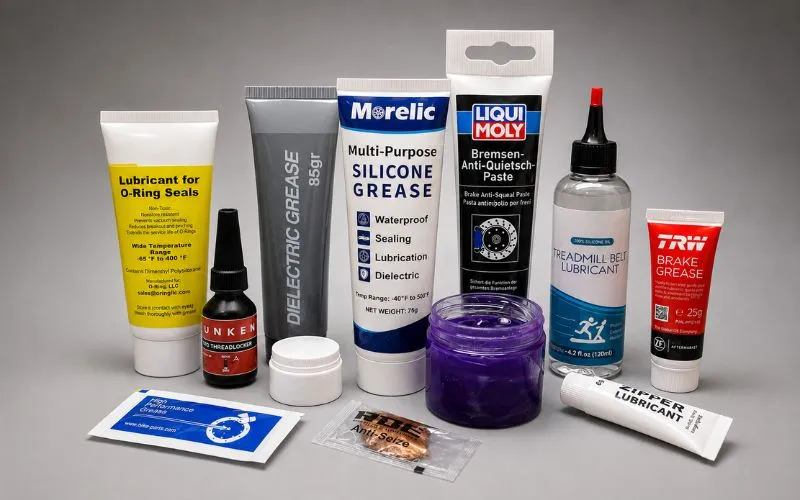
PFPE (Perfluoropolyether) lubricants are fluorinated synthetic oils and greases designed for extreme environments. Standard PFPE operate from –40°C to +250°C,Linear PFPE low-temp down to –75°C or –90°C, and provide exceptional chemical inertness, low volatility, and long service life. To select the right PFPE lubricant, evaluate three critical factors: operating temperature, load/speed conditions, and environmental exposure. Linear types (M, Z) excel in extreme temperatures, while pendent types (K, Y) offer superior load-carrying capacity.
What is PFPE Lubricant?
PFPE (Perfluoropolyether) lubricants are high-performance synthetic oils and greases composed of fluorinated polymers. They feature exceptional thermal stability, chemical inertness, oxygen compatibility, and low volatility. Their unique molecular structure with fluorine atoms surrounding carbon-oxygen chains creates a lubricant that excels where conventional options fail.
Video Guide: This video explains the fundamental properties of PFPE products and why they’re essential for extreme operating conditions.
What Are the Key Benefits of PFPE Lubricants?
PFPE lubricants are fully fluorinated synthetic fluids composed of carbon, oxygen, and fluorine atoms. Unlike hydrocarbon oils, their molecular structure is shielded by fluorine, which prevents oxidation and chemical attack.
This gives PFPE lubricants five defining advantages:
- Ultra-wide temperature range: Standard grades –40°C to +250°C; linear low-temperature grades down to –75°C or –90°C
- Exceptional chemical inertness: resistant to fuels, solvents, acids
- Low volatility: minimal evaporation in vacuum or high heat
- Oxygen compatibility: non-flammable and oxidation resistant
- Long service life: 3–5× longer than conventional synthetics
These properties make PFPE lubricants essential in aerospace, semiconductor, vacuum, oxygen service, and extreme industrial environments where conventional lubricants fail.
What are the different types of PFPE?
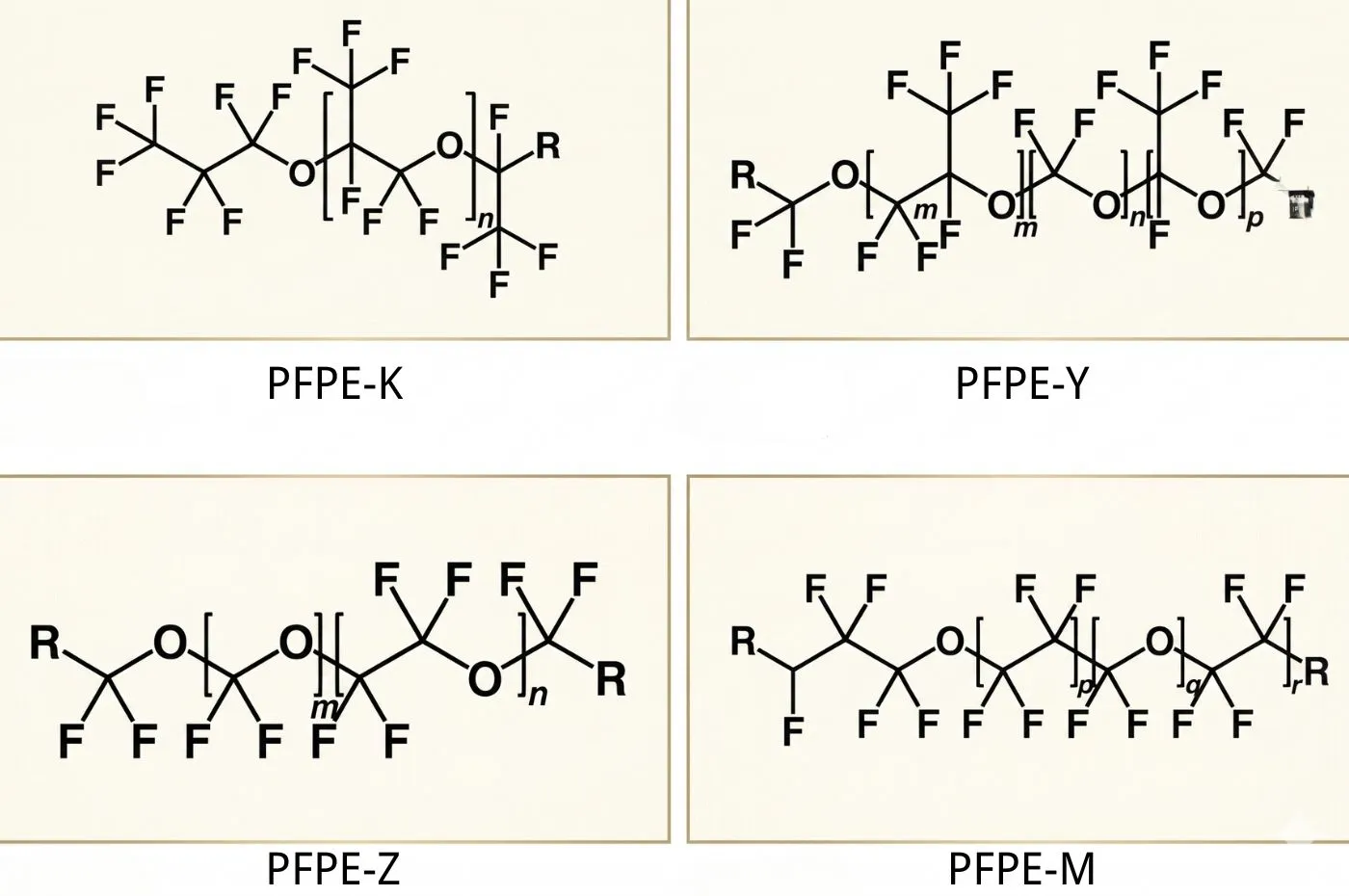
Although all PFPEs are composed of carbon, oxygen, and fluorine atoms, PFPE fluids fall into four different types—PFPE-K, PFPE-Y, PFPE-M, and PFPE-Z—or, in PFPE shorthand, K, Y, M, and Z fluids—depending on their specific molecular structures (the links of the carbon, oxygen, and fluorine atoms are different) and manufacturing processes.
These structural differences influence the fluids’ low-temperature performance, wear resistance, viscosity index, and volatility—all of which are critical factors to consider when selecting a PFPE lubricant.
Structural Classification
While molecular structure directly influences lubricating behavior, the distinction is straightforward:
Linear PFPEs (M, Z) feature flexible backbone chains that maintain fluidity at very low temperatures, making them ideal for cryogenic and low-torque applications.
Pendent PFPEs (K, Y) contain branched side groups that increase molecular rigidity, resulting in higher film strength and improved wear protection under heavier loads.
In short:
Linear = superior low-temperature flexibility.
Pendent = greater load-carrying capability.
PFPE Fluid Engineering Comparison
| Parameter | K & Y (Pendent PFPE) | M (Linear PFPE) | Z (Linear PFPE – Precision Grade) |
|---|---|---|---|
| Molecular Structure | Pendent (branched side groups) | Linear backbone | Linear backbone (optimized for low torque) |
| Recommended Continuous Service Range (°C) | -55 to 250 | -80 to 250 | -55 to 250 |
| Kinematic Viscosity @40°C (cSt) | 15 – 510 | 20 – 310 | 15 – 510 |
| Pour Point (ASTM D97) (°C) | -55 to -25 | -85 to -60 | -55 to -25 |
| Viscosity Index (ASTM D2270) | 60 – 135 | 250 – 340 | 60 – 135 |
| Low-Temperature Start Capability* | Approx. -35 to -40°C | Approx. -75°C | Approx. -90°C (low torque systems) |
| Film Strength (Relative) | High | Moderate | Moderate |
| Load-Carrying Capacity | High | Moderate | Moderate |
| Internal Friction / Torque Tendency | Moderate | Low | Very low |
| Volatility / Vapor Pressure | Very low | Extremely low | Extremely low |
| Primary Engineering Advantage | Mechanical robustness and wear resistance | Wide temperature stability and low volatility | Ultra-low torque and precision performance |
| Typical Engineering Applications | Gears, slides, heavy-load bearings, automotive and industrial assemblies | Wide-temperature bearings, semiconductor tools, vacuum systems | Precision bearings, sensors, actuators, optical and aerospace instruments |
*Low-Temperature Start Capability indicates approximate minimum functional temperature under low-load conditions and does not represent recommended continuous operating temperature.
How to Choose the Right PFPE Lubricant (Concise Selection Guide)
Selecting a PFPE lubricant follows a simple 3-step engineering filter: temperature → load/speed → environment.
1️⃣ Operating Temperature (Primary Filter)
Temperature determines base structure selection.
| Temperature Requirement | Recommended Type |
|---|---|
| Below –75 °C | PFPE-Z |
| –75 °C to –40 °C | PFPE-M |
| Above –40 °C + high load | PFPE-K / Y |
| Up to +250 °C continuous | All types (grade dependent) |
If temperature limits are exceeded, no other performance factor will compensate.
2️⃣ Load & Speed (Mechanical Stress Matching)
Structure and viscosity must match operating stress:
- Heavy load / slow speed → K or Y (higher film strength)
- High speed / precision systems → M (lower friction torque)
- Oscillating motion → Higher viscosity grade
- Extreme pressure → PFPE grease (PTFE thickened)
Always size viscosity to bearing diameter and RPM to prevent overheating or lubricant starvation.
3️⃣ Environmental Exposure (Chemical & Volatility Filter)
PFPE lubricants are typically chosen for severe environments:
- Vacuum → Z (lowest vapor pressure / outgassing)
- Chemical exposure → All PFPE types (high inertness)
- Oxygen service → Non-flammable, oxygen compatible
- Water / steam → Excellent washout resistance
- Radiation → Superior stability vs hydrocarbons
In harsh environments, prioritize chemical stability and volatility over cost.
Quick Application Matrix
| Application | Recommended Type | Key Property |
|---|---|---|
| Aerospace bearings | M or Z | Wide temp + low volatility |
| Semiconductor equipment | Z | Ultra-low outgassing |
| Automotive components | K or Y | Load capacity |
| Vacuum systems | Z | Lowest vapor pressure |
| High-speed bearings | M | Low friction |
| Extreme cold | Z | –90 °C capability |
| Heavy machinery | K | Film strength |
This framework enables fast first-pass selection before fine-tuning viscosity grade and thickener system.
Oil vs Grease: When to Choose Each
PFPE lubricants are available as both oils and greases.
Choose PFPE Oil when:
- High-speed bearings
- Circulating systems
- Low torque startup required
Choose PFPE Grease when:
- Sealed-for-life bearings
- Vertical shafts
- Shock loading
- Contamination protection needed
PFPE greases are typically thickened with PTFE for enhanced boundary lubrication.

Limitations of PFPE Lubricants
- Higher cost (PFPE-Z grease about $500/lb)
- Not miscible with mineral or PAO oils
- Requires thorough system cleaning before conversion
- Limited compatibility with certain reactive metals under extreme load
PFPE Lubricant – People Also Ask
What is PFPE lubricant used for?
PFPE lubricants are used in extreme environments such as aerospace bearings, semiconductor equipment, vacuum systems, and oxygen service components. They provide thermal stability, chemical inertness, and long-lasting lubrication where conventional oils fail.
What temperature range can PFPE lubricants handle?
Most PFPE lubricants operate from –40°C to +250°C. Linear types such as M and Z can function down to –75°C or –90°C for cryogenic environments.
Can PFPE lubricants be used in vacuum environments?
Yes. PFPE lubricants have extremely low vapor pressure and minimal outgassing, making them suitable for vacuum pumps, aerospace optics, and semiconductor systems.
Are PFPE lubricants safe for oxygen service?
Yes. PFPE lubricants are non-flammable, oxidation-resistant, and chemically inert, making them suitable for oxygen valves, regulators, and aerospace oxygen systems.
What is the difference between PFPE oil and PFPE grease?
PFPE oil is used in high-speed or circulating systems requiring low torque. PFPE grease, thickened with PTFE, provides better retention and higher load capacity in sealed bearings.
How long do PFPE lubricants last?
PFPE lubricants typically last three to five times longer than conventional synthetic lubricants due to their chemical inertness and oxidation resistance. In sealed systems operating within recommended temperature limits, service life can exceed 10 years.
Engineering Support & Application Guidance
Selecting the optimal PFPE lubricant is not just about temperature range—it requires balancing viscosity, load capacity, volatility, and system design.
If you are specifying lubrication for aerospace, semiconductor, vacuum, or oxygen service applications, technical validation is strongly recommended to ensure performance and safety compliance.
Our engineering team can assist with viscosity selection, grease formulation, and compatibility evaluation based on your operating conditions.